













































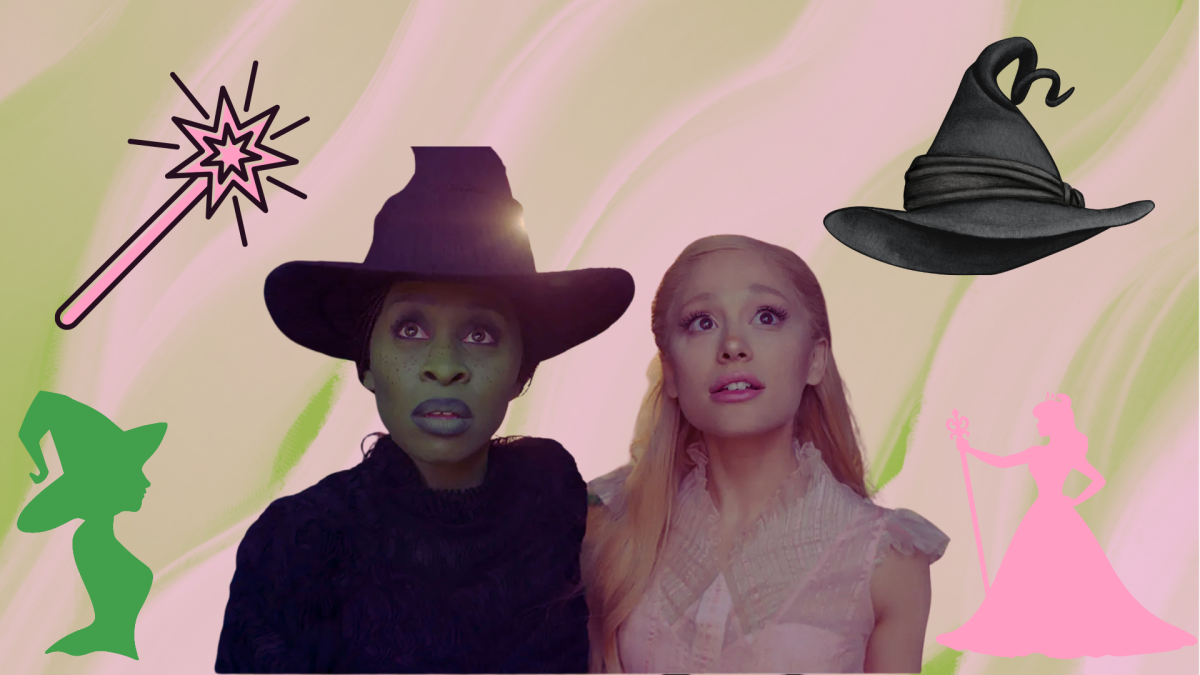
Like most people, I enjoyed Jon M. Chu’s 2024 musical, “Wicked.” Although the visuals and directing were not particularly interesting, the music, and plot were enough to have me upset that I had to wait a year to see the conclusion to the story. And after that year had passed, I excitedly sat down in the theater for “Wicked: For Good,” with the mindset that there was no way that the second part could be disappointing. Unfortunately, disappointment is always a possibility, and the higher expectations you have, the more you can be let down.
“Wicked: For Good,” picks up about a year after the first film. The main focus, still being Elphaba and Glinda, who now live two opposing lives. Elphaba openly opposes the Wizard, while trying to save the animals of Oz, while Glinda works for the Wizard.
Similar to the last film, the relationship between Elphaba and Glinda and their juxtaposing personalities is where the film succeeds most. Many of the film’s themes are displayed directly by these characters’ actions towards each other and their devotion to Oz. The most interesting being the complex reality and nuance of what it means to be “good.”
My biggest praise of this film is the exploration of this theme. Glinda could easily have been a hated character who viewers see as someone only acting for herself, but thanks to her nuanced performance, and the way the story allows for both her and Elphaba to accomplish good deeds despite their different attempts at change, she is arguably the highlight of the film.
Outside of Elphaba, and Glinda, I found myself pondering why characters were making decisions. Characters often behave drastically different than they did not only from the first film, but also mere scenes before, largely to allow for the story to forcibly tie to events in “The Wizard of Oz.” Nessarose, Fiyero, and Boq being the biggest culprits of this.
Another theme prevalent through the film is the oppression which comes from fascism, an important theme for the current American political climate. However, I couldn’t help but get frustrated by the unclear resolution on how to deal with fascism, as the solution in the film is simply that Elphaba happens to be the Wizard’s daughter (a twist which was obvious within the first fifteen minutes of the first film). This simple explanation neglects much of the film’s potential to dive deeper into interesting themes, and the contrasting opposition by both Elphaba and Glinda, which as I said before were very compelling.
Now, I can not blame much of the plot problems on the movie as it of course is based on the story from the Broadway musical, however there are many glaring issues with the filmmaking as well.
The film rushes through its long runtime, giving the viewer little time to breathe. It feels as though scenes and events happen strictly so that the film can tie to events from “The Wizard of Oz,” often neglecting an overarching plot. I struggle to even identify the main conflict, climax, and resolution. Despite the fast pace, making the film longer would not improve the film. “Wicked: For Good,” is 2 hours and 18 minutes, and the first film is 2 hours and 40 minutes, making this version of the story 133 minutes longer than the stage musical it is based on.
I actually enjoyed the first film, and do not have a problem that they extended the movie versions, breaking the story into two parts, but after seeing “Wicked: For Good,” there must have been a better point where the two films could split, leaving more time for the second part, which contains most of the character arcs, and important events.
Another issue I had with the film is the direction. After watching “Wicked,” and “Wicked: For Good,” I assumed the director, Jon. M Chu had never directed any musicals before. However, he has directed many, such as “Step Up 2: The Streets,” “Step Up 3D,” and “In the Heights.” Both “Wicked,” and “Wicked: For Good,” lack any sort of creative camera movement, or imaginative musical sequences. With sets that look cheap, still camera, and still actors and actresses, at many times, it felt like I was simply watching a recorded version of the stage play.
In spite of the land of Oz’s bright colors the Jon M. Chu decided to drain the film of saturation, or contrast, giving the viewer a visual experience equivalent to that of the RAW, unedited version of digital footage.
Jon M. Chu also fails at directing many of the actors. Outside phenomenal performances by Ariana Grande, Cynthia Erivo, Jonathan Bailey, and Jeff Goldblum (who practically is playing himself) cast members like Michelle Yeoh, Ethan Slater, and Marissa Bode are not given the proper direction to showcase the great actors they are. While “Wicked” shared all of the directorial problems, they were easy to ignore due to the compelling plot and great songs. In “Wicked: For Good,” these issues are glaringly obvious because the songs are generic, and the plot is too contrived and predictable to care about.
Jon M. Chu had the monumental and incredibly hard task of bringing one of the most successful Broadway musicals to the big screen, and for half the story, despite his uninspired directing, succeeded. “Wicked: For Good,” on the other hand, fails at nearly all the jobs it had the responsibility of accomplishing. It doesn’t justify the decision to split the story into two films, it doesn’t satisfactorily conclude the setup from the first film, and it actively makes the first film worse, due to the story’s conclusion.
For comments/questions about this story, DM us on Instagram @thewhitatrowan or email [email protected]