









































































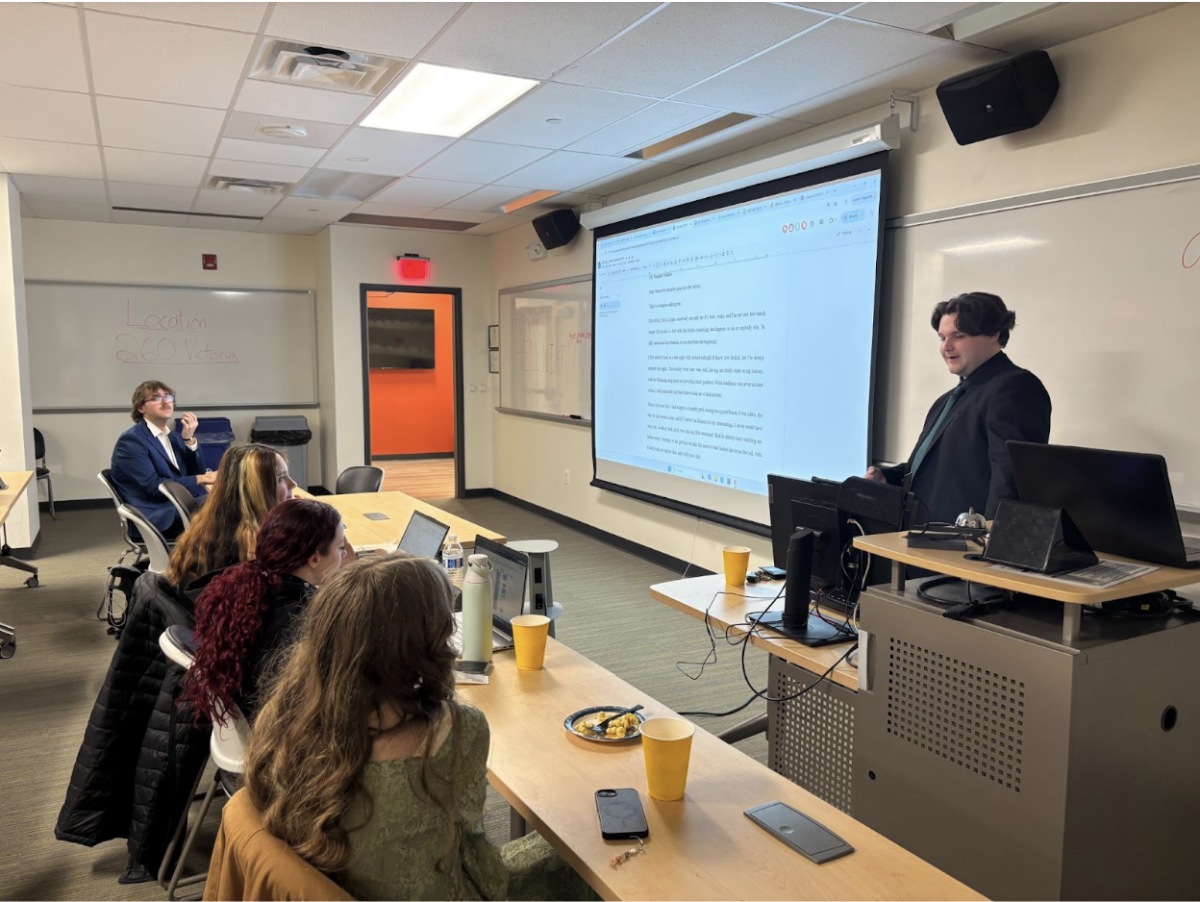


















With Rowan’s budget deficit still fresh in everyone’s minds, the University Senate met on a Zoom call this past Friday, with professors looking to get to the bottom of the situation.
Before discussing the budget, Senate President Bill Freind kicked off the meeting by approving several new Certificates of Undergraduate Study (CUGS) in the Theatre & Dance Department of the College of the Arts, such as theatrical sound design, theatrical costume design, theatrical lighting design, and theatrical scene design.
What followed next was a presentation on Rowan’s 2026 budget given by Joe Scully, Senior Vice President of Finance and Chief Financial Officer (CFO) at Rowan, and Michael Blake, Vice President of Budget and Financial Planning at Rowan. Currently, Rowan is projecting a budget deficit of $16.5 million in fiscal 2026, with approximately $7 million in revenue lost due to graduate and undergraduate international students being unable to obtain visas.
The deficit is also in large part due to several startup costs, specifically within Rowan Online, as well as the recently opened Shreiber School of Veterinary Medicine. Scully and Blake clarified that these programs will eventually generate additional revenue, yet are under the belief that Rowan’s budget for fiscal 2027 will also be in a deficit.
“Unfortunately, it’s not as quick as anybody likes. It does take time, and we definitely stand behind those investments and realize those returns may take a couple of years, but we fully expect those returns to happen,” said Blake.
When asked about whether or not Rowan had a deferred maintenance budget by art professor Skeff Thomas, Blake and Scully explained that while the university usually puts additional funds into deferred maintenance, there aren’t any funds in the budget for that currently.
“Each April, we come up with a university capitalist, and we’ll be putting forth two resolutions in this April’s board meeting. One will consist of approximately 13.5 million dollars worth of projects for the university that are considered deferred maintenance,” said Blake. “And then the other list, which is a little bit less, is for auxiliary type programs. I don’t have that exact number in front of me, but these go through the capital selection committee with various proposals that come forward.”
Following the presentation, Gregory Caputo, a professor in the Department of Biological and Biomedical Sciences as well as the Department of Chemistry & Biochemistry, inquired about the construction that’s been taking place on campus, questioning when new academic spaces would be constructed on campus while also acknowledging how Rowan has been reliant on state funds in the past for new buildings.
“Our university is thankfully in a good enrollment place, and I am concerned that as buildings age and we’re not putting up new academic buildings, especially buildings in the areas of focus of the university, and I’m going to pat the backs of my colleagues in chemistry and physics and biology,” said Caputo. “The biomedical sciences, engineering, STEM, that is what everybody is pushing our enrollment, which is also being driven by those students wanting to go to PA programs and vet programs and things like that. We need new space, and without capital investment, those buildings are getting more and more out of reach for us in terms of cost.”
Blake mentioned that a new building was currently in a design phase and would cost somewhere in the ballpark of $72 million, but the main issue with putting up new buildings is the university’s ability to pay for them. In addition to the cost of construction, there is also the cost of debt service, as well as the operational costs. According to the budget, Rowan has around $52 million dedicated to mortgage payments per year.
David Klassen, a professor in the College of Science and Mathematics who also acts as associate chair and astronomy coordinator, questioned whether or not any financial planning had been done in relation to the costs that would come with Rowan becoming an R1 university in the future.
“As we become R1, we are nowhere near funding this university as an R1 university, right? At an R1 university, graduate students have full tuition and fee waivers, graduate students have living wages. Faculty get an automatic sabbatical every seven years; they teach one or two loads. Has anyone done any planning on what that will cost and where we need to be in order to cover those costs in order to actually become an R1? Because until then, we’re basically asking students, faculty, and staff to work at an R1 level without having R1 level resources,” said Klassen.
Scully and Blake had not been involved in any long-term financial planning regarding Rowan’s potential shift to R1 status in the future, and were therefore unable to properly answer Klassen’s question.
The discussion then shifted to the anticipated growth of Rowan Online, as well as whether or not Rowan Online had been operating at a deficit or at a surplus so far.
“I believe we’re anticipating somewhere low double digits. I believe it was between 12 and 15 percent growth next year. It is running at a deficit, which was expected as we continue to build the infrastructure, in that fiscal ‘28 is when we expect the revenue to start outpacing the expenses as far as the increases are concerned,” said Scully.
According to the budget, the university plans on growing Rowan Online into one of the top 25 programs in the country. With this in mind, Rowan has chosen to hire new employees for Rowan Online rather than using employees that they already have, which Scully and Blake also addressed by mentioning how the goal for the current fiscal year was to see if some of the positions for Rowan Online that the university has been asking for could be filled with existing positions.
Rowan’s recently offered voluntary separation program was also on the agenda for the Senate meeting, and the question of how many people the university wanted to ideally take part in the program soon surfaced. At the time of the meeting, only 17 people had signed up for the program.
Based on estimates received from prior voluntary separation agreements, Rowan is aiming to get anywhere between $8 million and $10 million worth of salary, meaning they’d need somewhere between 80 and 90 individuals to participate, though several hundred are allegedly eligible for the program.
“A lot of people wait until closer to the deadline before they actually fill out the application, so at this point in time, we really don’t know for sure if we’re going to come close to the $8 million or not. I think having the workshops next week will help kind of set our minds up,” said Blake.
A follow-up question was asked regarding what would happen if Rowan doesn’t get enough people to opt into the voluntary separation program, to which Blake explained that, assuming that Rowan is able to get restoration for appropriations that they receive from the state, they’d have to determine if only $4 million worth of savings are realized from the voluntary separation agreement. From there, Blake continued, they’d have to calculate what their total budget is and get a feel for whether or not the budget deficit would be $10 million, $15 million, or $20 million.
“Now, we do have some reserves. Unfortunately, we’re going to dip into the reserves this year. I don’t want to continue to dip into reserves because obviously that’s not an endless pool of money. So it really is determined upon what we think that ultimate ‘27 budget is going to reside and then we’re going to have to make decisions based on that,” said Blake.
The final point of conversation on the agenda for the Senate was the situation regarding Adam Abrams, a mathematics professor at Rowan who had recently been pulled from teaching duties due to an investigation into his past as Adam Zydney, which was previously reported on in great detail by The Whit. Though briefly touched upon due to the meeting already running over time, Friend detailed the case to those in attendance at the Senate meeting and took part in a debate over the topic of name changes within the hiring process of faculty at the university.
“It was after talking with general counsel they agreed the best thing to do was a kind of voluntary separation where they would be paid for the rest of their contract, but would no longer teach, so I really can’t point any fingers here. Remember that New Jersey state law prohibits people hiring from considering cases that have been dismissed, and by the way I strongly support that,” said Freind. “If you can’t get a conviction, you are innocent. This case obviously is very different from most of those cases. The only question that I have, and that’s why I emailed Scott Agostini, is whether in the future we will research name changes. I’m not sure if we can do anything with that, but I will check into that, so that’s my overview.”
This served as the final full Senate meeting of the Spring 2026 semester, with an executive meeting to be held next Friday, April 24.
For comments/questions about this story, DM us on Instagram @thewhitatrowan or email [email protected]